
TODAY’S EPISODE IN PARTNERSHIP WITH BUILDINGPLAQUES.COM
→ Get your FREE LEED Recognition Plaque evaluation kit today!

The Green Impact Report Quick take: Most schools talk about sustainability. Jesse Michalski helped build one that actually runs on it.
In this episode, the longtime electrician and renewable energy specialist breaks down how a Wisconsin middle school became a net-zero energy success story —without sacrificing practicality, ROI, or resilience.
Meet Your Fellow Sustainability Champion

Jesse Michalski is a renewable energy specialist at Eland Electric, a third-generation electrical contractor based in Green Bay, Wisconsin.
With more than 20 years in the electrical trade, Jesse has helped lead commercial, residential, and K-12 solar installations across the Midwest.
He specializes in solar photovoltaic systems, battery storage, and resilient electrical infrastructure, helping clients future-proof buildings while reducing operational costs and carbon emissions.
Breaking Ground on Better Building
Key Insight #1: Net-zero buildings don’t happen by accident — they’re designed “solar ready” from day one
The Challenge: Many buildings attempt to add renewables after construction, forcing expensive retrofits, structural upgrades, and electrical redesigns.
The Solution: Jesse and his team worked with architects early in the Menasha Maplewood School project to ensure the building was structurally and electrically prepared for future solar and battery storage.
ROI: The school avoided costly retrofit work later, streamlined installation, and successfully delivered a net-zero energy facility with geothermal heating, solar power, and battery backup.
Key Insight #2: Battery storage means different things depending on where you live
The Challenge: Building owners often assume batteries automatically create financial savings everywhere.
The Solution: Jesse explained how battery economics depend heavily on local utility policies and net metering rules. In Wisconsin, batteries are primarily used for resiliency and backup power, while in states like California they also help avoid losing excess solar generation to the grid.
ROI: Smart battery integration can provide backup power during outages, reduce generator maintenance, and maximize energy savings where utility pricing structures support it.
Key Insight #3: The future of residential resiliency may already be parked in your driveway
The Challenge: Homeowners want resilient backup power systems but often struggle with battery costs and infrastructure decisions.
The Solution: Jesse highlighted the rise of vehicle-to-home (V2H) and vehicle-to-grid (V2G) technology, allowing EV batteries to temporarily power homes during outages.
ROI: Homeowners may soon leverage existing EV batteries as whole-home backup systems, reducing the need for standalone storage investments while increasing grid flexibility.
Sustainable Soundbite
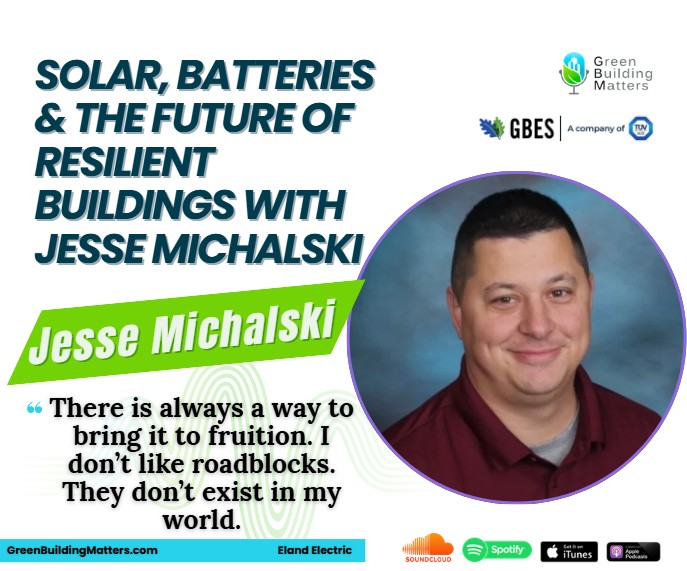
Your Green Building Action Plan
Transform your next project with these steps:
This Week: Audit whether your next project is truly “solar ready,” including roof load capacity, conduit pathways, and electrical infrastructure.
This Quarter: Evaluate battery storage opportunities based on your state’s utility incentives, net metering policies, and resiliency needs.
This Year: Build cross-functional collaboration earlier between architects, engineers, electricians, and renewable energy specialists to future-proof projects from day one.
Connect & Learn More
🌿 Access full episode resources: Green Building Matters Podcast
💚Join the Green Building Movement
📄 Read the transcript: HERE
🔗 Connect with Jesse Michalski:

Don’t forget to catch more episodes and resources for all of your green building news at the Green Building Matters website.
✉️ Want More Green Building Insights?
Get sustainability tips 2x a week.
Subscribe to our FREE newsletter here:

Green Building Matters, Inc © 2026 | Good Green Fun