
TODAY’S EPISODE IN PARTNERSHIP WITH BUILDINGPLAQUES.COM
→ Get your FREE LEED Recognition Plaque evaluation kit today!

🎯 The Green Impact Report Quick take: Marty Rozmanith spent seven years writing the requirements for Revit — the tool that runs $1.2B a year in the AEC industry — and now he’s building what comes after it. His pitch: pair AI with discrete engineering solvers so every design choice is explainable, not just fast, and use that to strip the padding owners quietly add to every project “just in case.”
🎓Meet Your Fellow Sustainability Champion
Charlie Cichetti

Co-Founder & CEO of Skema.ai, serial entrepreneur, LEED Fellow, and longtime sustainability advocate.
Charlie has spent his career helping building owners operate smarter, greener, and more efficiently.
Today, he’s focused on building a tech startup using AI to dramatically reduce waste, inefficiency, and rework across the building lifecycle.
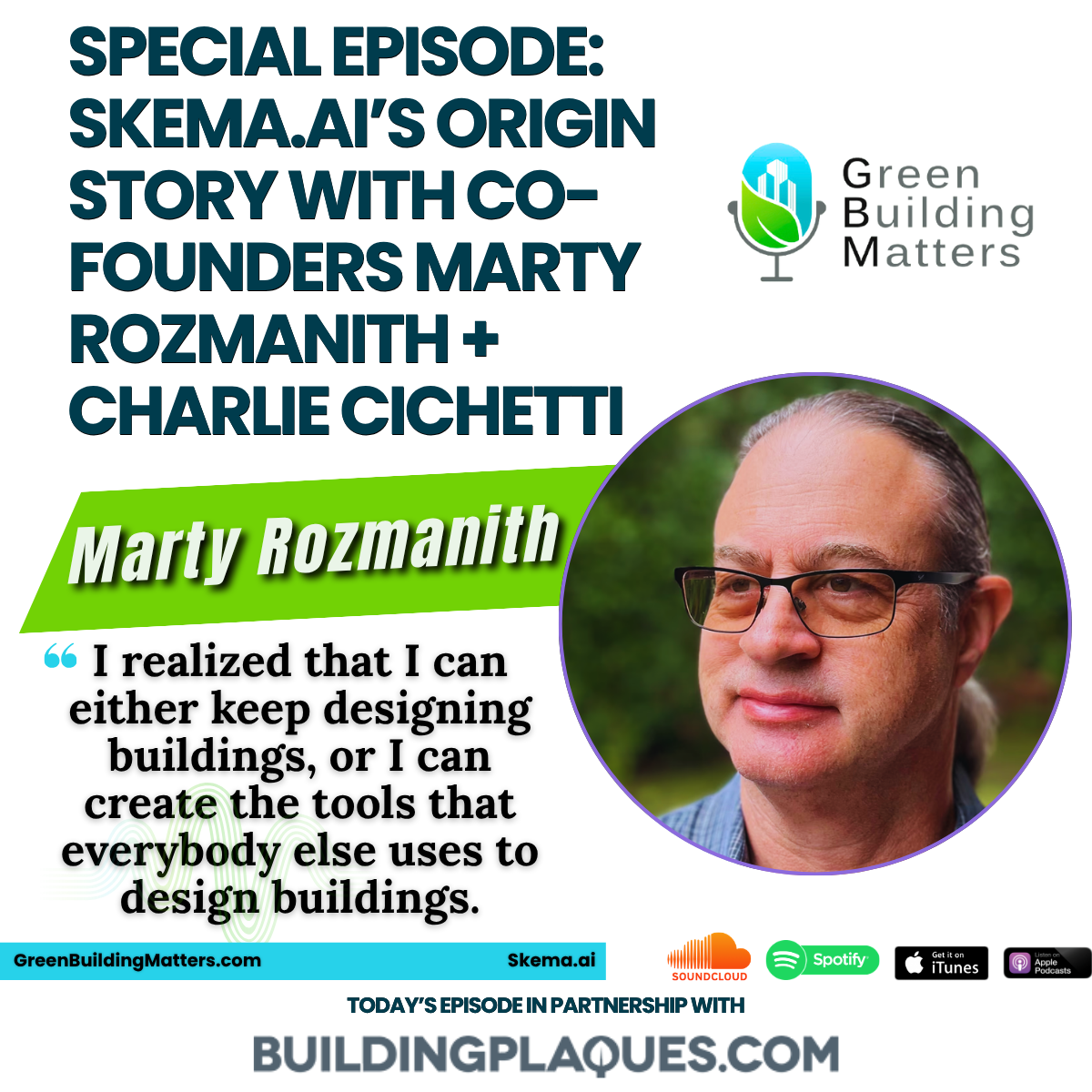
Marty Rozmanith

Co-Founder & CTO of Skema.ai. He started his career as a carpenter on a framing crew before earning an engineering degree and working in architecture and structural engineering.
He later joined Autodesk and was recruited onto the original Revit team, where he ran the Revit product requirements group for its first seven years – shaping features still core to the product today.
After Revit, he worked at Dassault Systèmes, the French engineering-software giant behind the design tools used across multiple industries, before co-founding Skema.ai in 2022 with Charlie Cichetti (and others) to bring that same rigor to buildings.
🌱Breaking Ground on Better Building
In this episode, Marty Rozmanith revolutionizes traditional construction approaches:
🧠Key Insight #1: Pairing AI with discrete solvers so every design decision has a documented reason
The Challenge: AI alone is a black box — ask it the same design question ten times and it can produce ten different answers, which is a non-starter when a licensed engineer has to sign off and explain a decision.
The Solution: Skema.ai combines traditional discrete-math solvers (which handle the hard engineering constraints — cooling, power, layout) with AI that learns to navigate hundreds of interdependent variables and explain why it made each trade-off.
ROI: Owners get repeatable, defensible design output — like a data center configuration that names the exact constraint behind every chiller count — without sacrificing the speed AI promises.
🧠Key Insight #2: “Morphing” — reusing what architects already built instead of starting from a blank page
The Challenge: Most cloud design tools ask architects to rebuild their entire library of assemblies and details from scratch, and early feasibility software forced designers to work only from a rigid pre-built “parts bucket,” which architects hated and refused to adopt.
The Solution: Skema.ai lets firms take an assembly from a past project and adapt it to a new site and shape, instead of redrawing it — giving designers flexibility while still capturing reusable data.
ROI: Faster time from concept to a permit-ready model, plus firms build a growing library of their own best practices instead of losing that knowledge project to project.
🧠Key Insight #3: Selling directly to owners to eliminate the hidden “CYA tax.”
The Challenge: Every stakeholder in a project — architect, engineer, contractor — tends to pad their estimate “just in case,” a habit Rozmanith and Cichetti call the CYA tax, which typically adds 10–25% to project cost.
The Solution: Skema.ai gives owners an in-house tool that non-technical team members can use to produce a highly technical, 75%+ complete design before the architect of record is even brought in — and gives every party access to the same live data at once, removing the excuse to pad.
ROI: For portfolio owners like quick-service restaurants and data center operators, even modest per-project savings compound fast — the team points to one retail customer where five extra store openings in a year could move $60M+ in revenue forward.
Sustainable Soundbite
🤗 Your Green Building Action Plan
Transform your next project with these steps:
This Week: Pull your last three project budgets and estimate the “CYA tax” — the contingency padding added by each party just in case. You can’t cut what you haven’t measured.
This Quarter: Pilot an AI-assisted workflow on one repeatable project type (a prototype store, a standard floor plate) where the tool has to explain why it made each trade-off — not just produce an answer.
This Year: Build an integration strategy, not a replacement strategy. Look for tools that plug into what your team already uses (Revit, SketchUp, Rhino) so adoption doesn’t carry a switching-cost tax of its own.
Connect & Learn More
🌿 Access full episode resources: Green Building Matters Podcast
💚Join the Green Building Movement
📄 Read the transcript: HERE
🔗 Connect with Marty Rozmanith:

🤩 Want More Green Building Insights?
Don’t forget to catch more episodes and resources for all of your green building news at the Green Building Matters website.
Get sustainability tips 2x a week.
Subscribe to our FREE newsletter here:

🤝 Today’s Episode Sponsored By: BuildingPlaques.com
BuildingPlaques.com helps project teams showcase the story behind their LEED and green building certifications with fully customized architectural plaques.
Highlight your scorecard, sustainability strategy, project team, and certifications in one sleek display designed to educate and inspire building occupants.
Green Building Matters, Inc © 2026 | Good Green Fun