
TODAY’S EPISODE IN PARTNERSHIP WITH BUILDINGPLAQUES.COM
→ Get your FREE LEED Recognition Plaque evaluation kit today!

🎯 The Green Impact Report Quick take: What if the greenest building innovation isn’t waiting around the corner — it’s already here?
New Energy Works founder Jonathan Orpin makes the case for building better now, using durable timber structures, wood-fiber insulation, off-site construction, and mass timber to tackle carbon without sacrificing craft or economics.
🎓Meet Your Fellow Sustainability Champion

Jonathan Orpin is the founder of New Energy Works, a timber framing and sustainable construction company celebrating 40 years in business.
Jonathan’s environmental roots stretch back to college, when he became deeply interested in environmentalism. New Energy Works initially explored cellulose insulation and solar energy before pivoting toward timber framing in the mid-1980s.
Four decades later, the company works across residential timber framing, off-site panelization, glulam, and mass timber construction. New Energy Works is also 100% employee owned through an ESOP and operates around a triple-bottom-line philosophy of People, Planet, and Profit.
Now, Jonathan is preparing for another kind of sustainable design challenge: building a leadership transition that allows the company and its values to thrive beyond its founder.
🌱Breaking Ground on Better Building
In this episode, Jonathan challenges Green Building professionals to stop waiting for the next breakthrough and start scaling solutions we already know work:
🧠Key Insight #1: Build the enclosure like a blanket — and attack thermal bridging from the outside
The Challenge: Conventional assemblies can introduce thermal bridges through studs and other structural components, while some insulation products carry significant global warming impacts of their own.
The Solution: New Energy Works wraps its timber structures with exterior insulation and has increasingly shifted toward wood-fiber insulation. The company uses dense-packed wood fiber in cavities and rigid wood fiber outside the structure to break thermal bridges. Jonathan points to domestically manufactured wood-fiber insulation made from lower-grade trees as an especially exciting evolution.
ROI: Better thermal performance can reduce operational energy demand, while wood fiber provides a lower-carbon insulation strategy. Off-site panelization also helps move work into a controlled shop environment, reducing field labor and accelerating installation.
🧠Key Insight #2: Stop treating mass timber as “next.” It’s ready now
The Challenge: Concrete and steel remain foundational materials for commercial construction, but Jonathan argues their carbon impacts create an opportunity for lower-carbon structural alternatives.
The Solution: New Energy Works is expanding its glulam and mass timber work on commercial projects, bringing wood into structures that might otherwise have relied more heavily on concrete and steel.
ROI: Mass timber gives project teams another lever for addressing embodied carbon while creating highly crafted buildings. For Jonathan, the bigger opportunity is implementation: Green Building professionals already know enough to make better material decisions today.
🧠Key Insight #3: Sustainability includes building companies—and buildings—that can outlast their founders
The Challenge: A durable building means little if the knowledge, culture, and values behind it disappear. Jonathan sees the same longevity challenge in business ownership as he does in construction.
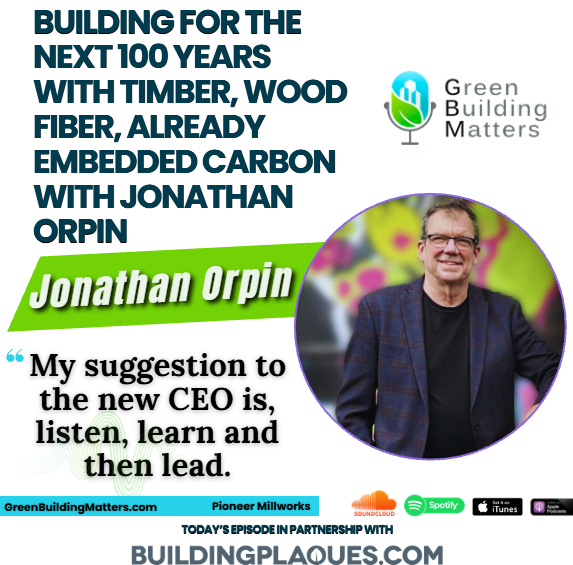
The Solution: New Energy Works became 100% employee owned through an ESOP as part of a long-term succession strategy. Jonathan is now preparing to transition from CEO to executive chair while searching for a leader who will preserve the company’s commitment to community, craft, and People, Planet, and Profit. His advice to that future CEO is simple: listen, learn, then lead.
ROI: Employee ownership creates a pathway for workers to participate in the value they help create while giving the company a succession mechanism designed to preserve its culture and mission. For founders, succession planning can turn decades of work into an organization capable of continuing beyond them.
Sustainable Soundbite
🤗 Your Green Building Action Plan
Transform your next project with these steps:
This Week: Review one current wall or roof assembly for thermal bridges and investigate whether wood-fiber insulation or continuous exterior insulation could improve the enclosure.
This Quarter: Identify where your project could reduce reliance on higher-carbon structural materials and evaluate timber, glulam, mass timber, and FSC-certified wood where appropriate.
This Year: Start measuring instead of assuming. Establish a repeatable process for tracking the carbon impacts of your materials and projects so your sustainability claims can increasingly be backed by data.
Connect & Learn More
🌿 Access full episode resources: Green Building Matters Podcast
💚Join the Green Building Movement
📄 Read the transcript: HERE
🔗 Connect with Jonathan Orpin:

🤩 Want More Green Building Insights?
Don’t forget to catch more episodes and resources for all of your green building news at the Green Building Matters website.
Get sustainability tips 2x a week.
Subscribe to our FREE newsletter here:

🤝 Today’s Episode Sponsored By: BuildingPlaques.com
BuildingPlaques.com helps project teams showcase the story behind their LEED and green building certifications with fully customized architectural plaques.
Highlight your scorecard, sustainability strategy, project team, and certifications in one sleek display designed to educate and inspire building occupants.
Green Building Matters, Inc © 2026 | Good Green Fun