
TODAY’S EPISODE IN PARTNERSHIP WITH BUILDINGPLAQUES.COM
→ Get your FREE LEED Recognition Plaque evaluation kit today!

🎯 The Green Impact Report Quick take: The future of high-performance buildings isn’t necessarily about adding more technology — it’s about making smarter decisions. Mechanical engineering leader Dale Garfield breaks down why fundamentals, heat pumps, renewable-ready infrastructure, and owner-focused design matter as buildings move toward a lower-energy future.
🎓Meet Your Fellow Sustainability Champion

Dale Garfield’s path to building engineering started somewhere unexpected: the United States Marine Corps.
After serving as a combat engineer — including a deployment to Iraq — Dale returned to Wisconsin and began studying civil engineering technology at Mid-State Technical College. An instructor encouraged him to take the next step, eventually leading him to Milwaukee School of Engineering’s Architectural Engineering Program.
Since graduating, Dale has built a career spanning engineering firms, mechanical contractors, design-build environments, and integrated architecture and engineering.
Today, he is a Mechanical Engineering Leader at EUA, where his experience touches projects ranging from K-12 schools and manufacturing facilities to corporate headquarters and shipbuilding facilities.
Along the way, Dale also earned an executive MBA to strengthen the business and leadership side of his technical career.
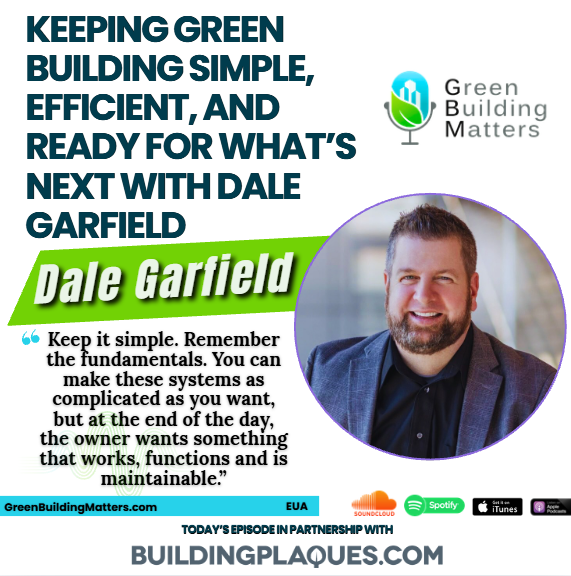
His approach to buildings is refreshingly straightforward: understand what matters to the owner, remember the fundamentals, and don’t make a system more complicated than it needs to be.
🌱Breaking Ground on Better Building
In this episode, Dale shares a practical engineer’s perspective on making buildings more efficient without losing sight of the people who have to own, operate, and maintain them.
🧠Key Insight #1: High-performance design starts with the owner—not the technology
The Challenge: Sustainability can become an exercise in adding technology without first asking what the owner actually wants, needs, or can support. Budgets, operational capabilities, energy goals, and long-term priorities vary significantly from project to project.
The Solution: Dale starts with the owner’s expectations and builds efficiency into the design from there. That can mean variable frequency drives, condensing boilers, high-efficiency chillers, heat pumps, and other proven strategies — without overengineering the building simply for the sake of complexity.
ROI: Owners get efficient systems aligned with their real operational and financial needs. Just as importantly, they get buildings that work and systems their teams can maintain.
🧠Key Insight #2: Heat pumps can push efficiency forward—but mechanical systems can’t get buildings to net zero alone
The Challenge: Engineers can improve heat recovery, heat pumps, chillers, and HVAC performance, but there’s a physical limit to how far mechanical efficiency can go. As Dale points out, engineers still have to work within the fundamentals of thermodynamics.
The Solution: Combine increasingly efficient mechanical systems with onsite renewable energy. Dale is also seeing projects prepare for the future by designing structural and electrical infrastructure that can support photovoltaic arrays later — even when solar isn’t part of the initial construction.
ROI: Solar-ready and renewable-ready infrastructure gives owners flexibility. Instead of paying for every sustainability measure on day one, they can create a building capable of adapting as economics, technology, energy priorities, and requirements change.
🧠Key Insight #3: The best engineering solution is often the simplest one that actually works
The Challenge: Engineers can be tempted to solve problems with increasingly complicated systems. Complexity can create its own problems when owners and facilities teams eventually have to operate, troubleshoot, and maintain those systems.
The Solution: Dale returns to a lesson he learned early in his career: keep it simple and remember the fundamentals. He also believes engineers need to stick with problems when they occur instead of distancing themselves when a project gets difficult.
ROI: Straightforward, maintainable systems can reduce operational headaches while giving owners something arguably even more valuable: confidence that their engineering team will remain engaged when challenges arise.
Sustainable Soundbite
🤗 Your Green Building Action Plan
Transform your next project with these steps:
This Week: Ask what sustainability and energy performance actually mean to the owner before recommending another technology. Start with their priorities, operating realities, and long-term goals.
This Quarter: Review an upcoming project for opportunities to improve mechanical efficiency without unnecessary complexity. Look at proven strategies such as heat pumps, heat recovery, variable frequency drives, high-efficiency equipment, and practical controls.
This Year: Start designing for what the building may need next—not just what gets installed today. Explore solar-ready structural and electrical infrastructure and other strategies that can create a pathway toward lower-energy or net-zero-capable buildings.
Connect & Learn More
🌿 Access full episode resources: Green Building Matters Podcast
💚Join the Green Building Movement
📄 Read the transcript: HERE
🔗 Connect with Dale Garfield:

🤩 Want More Green Building Insights?
Don’t forget to catch more episodes and resources for all of your green building news at the Green Building Matters website.
Get sustainability tips 2x a week.
Subscribe to our FREE newsletter here:

🤝 Today’s Episode Sponsored By: BuildingPlaques.com
BuildingPlaques.com helps project teams showcase the story behind their LEED and green building certifications with fully customized architectural plaques.
Highlight your scorecard, sustainability strategy, project team, and certifications in one sleek display designed to educate and inspire building occupants.
Green Building Matters, Inc © 2026 | Good Green Fun