
TODAY’S EPISODE IN PARTNERSHIP WITH BUILDINGPLAQUES.COM
→ Get your FREE LEED Recognition Plaque evaluation kit today!

🎯 The Green Impact Report Quick take: What if a coating 1 millimeter thick could insulate like a thick layer of conventional material, and you could prove it without waiting a year on a pilot?
Nathan Kegel spent 20-plus years in energy modelling. Now he’s at a materials science startup, building the simulation engine that tests its products before they ever reach a roof.
🎓Meet Your Fellow Sustainability Champion

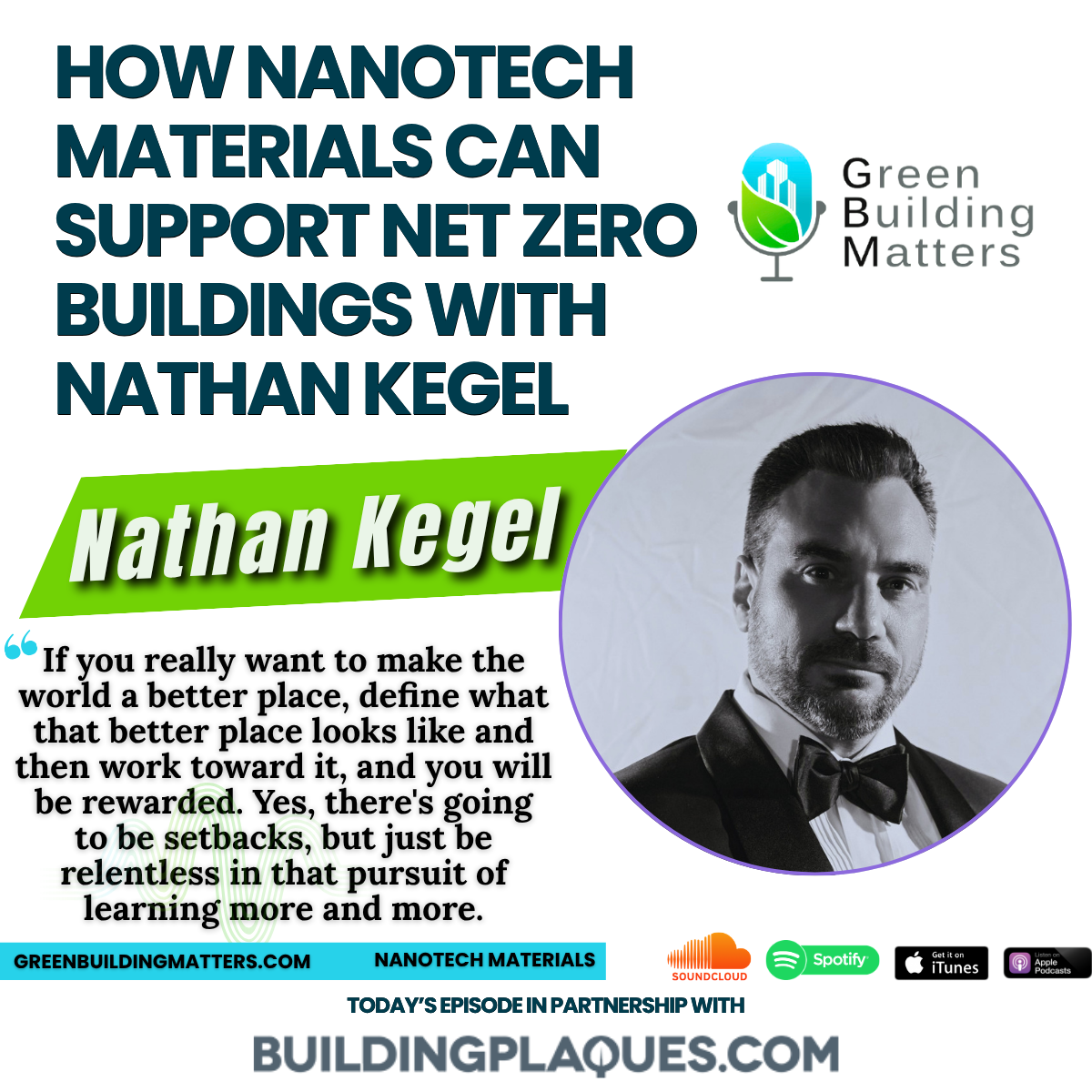
Nathan Kegel leads energy services at Nanotech Materials. He grew up outside Green Bay, Wisconsin, working on a neighbor’s sweet corn farm (and he’s still a Packers fan). He studied at the University of Minnesota and started out designing HVAC and plumbing systems. He soon moved into energy simulation, the part of the job he found more interesting.
Over about 20 years he worked on some of the early net zero and LEED Platinum lab projects in California and built building performance teams at architecture and engineering firms. He also spent roughly a decade, on and off, at IES, helping bring advanced building simulation software to North America. He’s based in the Twin Cities and reads philosophy and the classics for fun.
🌱Breaking Ground on Better Building
In this episode, Nathan Kegel rethinks how we insulate buildings and how we prove that new materials work:
🧠Key Insight #1: Insulation doesn’t have to mean thickness
The Challenge: The industry rates insulation by R-value, and thickness is part of that calculation. More resistance has meant more material, more depth and more weight. Nathan half-jokes that R-value is “the bane of my existence.”
The Solution: Nanotech Materials puts a silica-based particle into coatings like acrylics and epoxies. Nathan says the particle has a K-value (thermal conductivity) on par with aerogel, without aerogel’s brittleness. Applied about 1 millimeter thick on a roof, the coating can essentially stop heat conduction through it.
ROI: According to Nathan, the roof product is rated for Florida’s 200 mph impact standard. A related spray-on coating, developed with the state of California, protects timber from wildfire and resists heat up to 1,800°C with very low smoke. You get thermal performance and resilience from one thin layer.
🧠Key Insight #2: Stop running endless pilots
The Challenge: A startup can’t coat a roof and wait a year to see if it worked. As Nathan puts it, “you might not be in business a year.” Slow field pilots stall innovation across the industry.
The Solution: One of Nanotech’s co-founders built a new physics engine from scratch rather than relying on older simulation code. It has been validated under ASHRAE Standard 140. Nathan is bringing it to market, starting with services and eventually opening the full platform to project teams.
ROI: Validated simulation means faster, more confident decisions about new materials. Teams can predict performance instead of waiting for it.
🧠Key Insight #3: Coat the pipe instead of jacketing it
The Challenge: Traditional pipe insulation needs aluminum-jacketed systems that take a lot of labor to install. Moisture can also get trapped between the insulation and the pipe, which causes corrosion under insulation (CUI).
The Solution: A coating a couple of millimeters thick, adhered directly to the metal, stops heat transfer without the jacket.
ROI: Nathan says this greatly reduces labor costs and nearly prevents corrosion under insulation, so the system costs less upfront and lasts longer.
Sustainable Soundbite
🤗 Your Green Building Action Plan
Transform your next project with these steps:
This Week: Do the jargon check Nathan recommends. Before your next presentation to an owner or your boss, figure out who the audience is, list your technical jargon, and rewrite your pitch at their level.
This Quarter: Find one place where thickness drives your current spec, such as roof insulation, pipe jacketing or a retrofit with tight clearances. Ask what thin-film or high-performance coating alternatives would do to cost, labor and durability.
This Year: Start with the end in mind. Don’t ask “What will building design look like in 2030?” Define what you want your projects, team or firm to look like, then work backward and use energy modeling to test the path before you commit.
Connect & Learn More
🌿 Access full episode resources: Green Building Matters Podcast
💚Join the Green Building Movement
📄 Read the transcript: HERE
🔗 Connect with Nathan Kegel:
Visit us at At the Greenbuild 2026 International Conference + Expo, NanoTech Materials is located at Booth #1049

🤩 Want More Green Building Insights?
Don’t forget to catch more episodes and resources for all of your green building news at the Green Building Matters website.
Get sustainability tips 2x a week.
Subscribe to our FREE newsletter here:

🤝 Today’s Episode Sponsored By: BuildingPlaques.com
BuildingPlaques.com helps project teams showcase the story behind their LEED and green building certifications with fully customized architectural plaques.
Highlight your scorecard, sustainability strategy, project team, and certifications in one sleek display designed to educate and inspire building occupants.
Green Building Matters, Inc © 2026 | Good Green Fun