
TODAY’S EPISODE IN PARTNERSHIP WITH BUILDINGPLAQUES.COM
→ Get your FREE LEED Recognition Plaque evaluation kit today!

🎯 The Green Impact Report Quick take: LEED used to be the strategy. Now it’s one of maybe 20 tools. Marianna Palmour went from reviewing LEED projects to building a corporate ESG program from scratch at a 5,000-person firm, and she explains why your biggest clients’ Scope 3 targets are about to become your problem.
🎓Meet Your Fellow Sustainability Champion

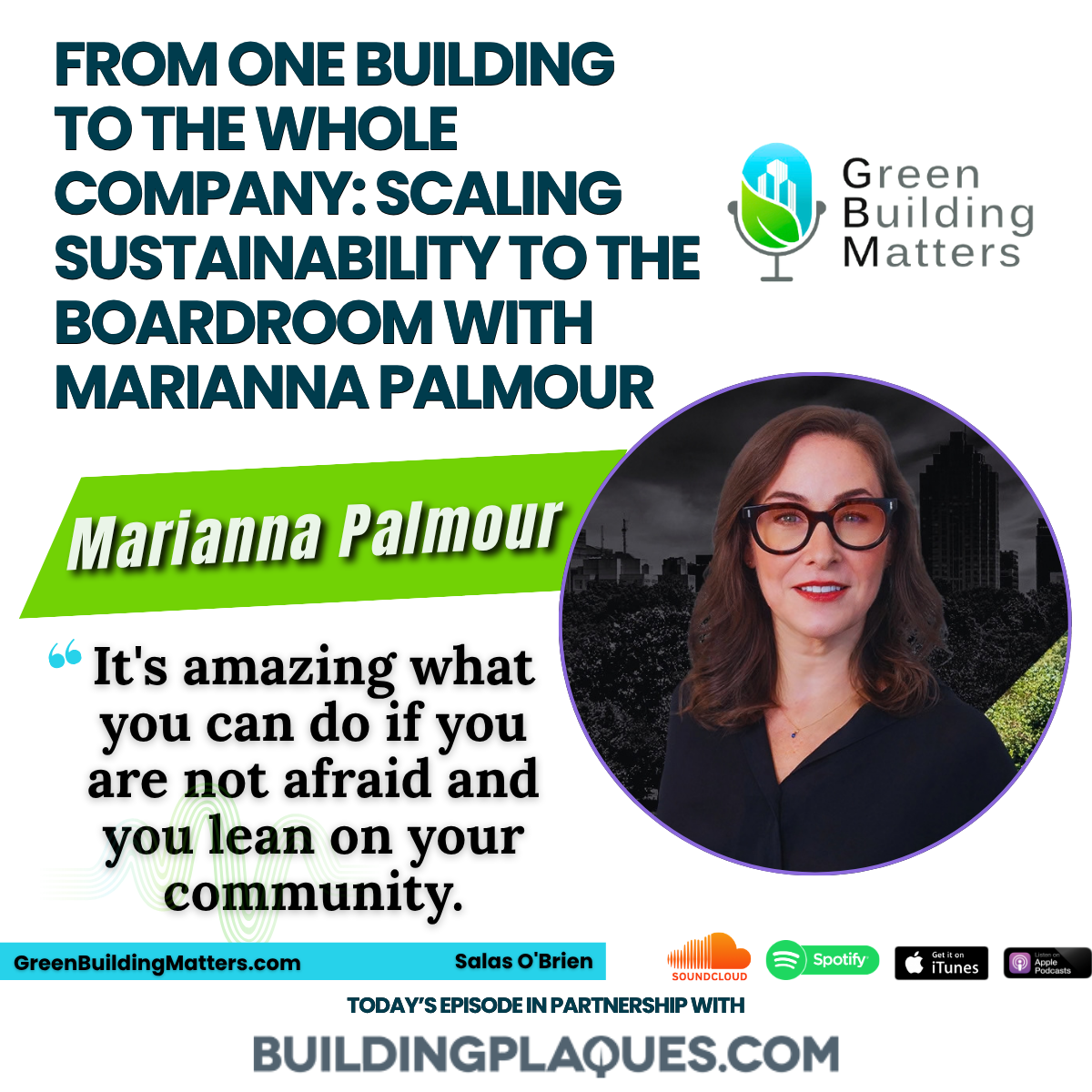
Marianna Palmour leads corporate sustainability at Salas O’Brien, an engineering and technical services firm with more than 5,000 people. She grew up on Lookout Mountain in northwest Georgia, studied architecture at Georgia Tech, and got into green building early. She took the LEED exam straight out of school and served as vice president and past president of USGBC’s Emerging Green Builders.
From there she worked at Sustainable Options and then Epstein Group, where she was a LEED third-party reviewer and built out a portfolio and ESG service line. She went back to Georgia Tech for an MBA in entrepreneurship, which made her a “double Jacket.” While there she was a fellow with the Ray C. Anderson Center for Sustainability, focused on inclusive design. When Salas O’Brien acquired Epstein Group, she was asked to build the ESG program from the ground up.
🌱Breaking Ground on Better Building
In this episode, Marianna Palmour shows how sustainability moves from the building to the boardroom:
🧠Key Insight #1: Double materiality beats copying the competition
The Challenge: Companies often set sustainability goals by looking at what peers are doing, or by asking only the people at the top.
The Solution: Run a materiality assessment that asks every stakeholder: communities, investors, the board, clients and suppliers. Then look at it in both directions (“double materiality”): how sustainability issues affect the business, and how the business affects the environment.
ROI: The strategy fits your own values, your regulatory exposure (Local Law 97 in New York, California’s ESG disclosure rules) and the people you actually answer to. You don’t spend money chasing someone else’s priorities.
🧠Key Insight #2: Your clients’ Scope 3 is now your compliance problem
The Challenge: Smaller firms and service providers assume EU rules and emissions reporting only apply to big multinationals.
The Solution: Get ready now. Big global clients have to report Scope 1, 2 and 3 emissions, so they’re pushing supplier codes of conduct and emissions reporting down the supply chain. That includes consultants. Marianna’s simple test: Scope 1 is fuel you burn yourself, Scope 2 is energy someone else produces for you, and Scope 3 is everything upstream and downstream.
ROI: A $20K job might not get noticed. Millions in work puts you in a client’s Scope 3 footprint. Firms that can sign off on supplier standards and report their emissions keep those relationships and stay eligible for the work.
🧠Key Insight #3: Make the business case in two languages
The Challenge: Green policies usually get written one building or one office at a time, and leadership sees them as a nice-to-have.
The Solution: Early in her career, Marianna took the Georgia-Pacific tower in downtown Atlanta (over a million square feet) through one of the first big LEED EBOM v2009 certifications. It was the first time she had to convince a C-suite that operational changes were right on values and on economics. She now brings that approach to whole portfolios, turning energy, water and indoor air quality strategies into standards that work across cities, countries and regulations.
ROI: Policies adopted across the whole organization save money and resources everywhere at once, not just in one showcase building.
Sustainable Soundbite
🤗 Your Green Building Action Plan
Transform your next project with these steps:
This Week: Pull the supplier codes of conduct from your top three clients and compare them with your own policies. If you can’t attest to them today, find out why.
This Quarter: Run a light materiality assessment. Survey employees, key clients, suppliers and leadership about which sustainability issues matter most to them, and look at both sides of double materiality.
This Year: Take one strategy that worked on a single building (an energy, water or IEQ policy) and write it up as a standard for your whole portfolio or company. Then start tracking the Scope 3 data your biggest clients will eventually ask for.
Connect & Learn More
🌿 Access full episode resources: Green Building Matters Podcast
💚Join the Green Building Movement
📄 Read the transcript: HERE
🔗 Connect with Marianna Palmour:

🤩 Want More Green Building Insights?
Don’t forget to catch more episodes and resources for all of your green building news at the Green Building Matters website.
Get sustainability tips 2x a week.
Subscribe to our FREE newsletter here:

🤝 Today’s Episode Sponsored By: BuildingPlaques.com
BuildingPlaques.com helps project teams showcase the story behind their LEED and green building certifications with fully customized architectural plaques.
Highlight your scorecard, sustainability strategy, project team, and certifications in one sleek display designed to educate and inspire building occupants.
Green Building Matters, Inc © 2026 | Good Green Fun